We recently received a pair of Beyerdynamic Aventho 300 wireless over-ear headphones for review in our SoundGale studio. So, today, we'll discuss this headphone model's features and characteristics in depth and we'll also share our impressions of their sound quality. Admittedly, we didn't generate much intrigue in the article from the outset – the headline reveals our personal impressions outright. But what's so surprising about that? Trust in the brand – Check. Form factor – check. Wireless connectivity and codecs – check. The set of features you get starts long before you open the box. What did you expect? Even before they leave the shelf, these headphones sense the expectations of their future owners. It's worth admitting that they will almost certainly live up to your expectations. But not all of them, and not for everyone. The company is still more focused on sound quality than on gadgets. This has not affected the overall picture, but has slightly shifted the emphasis of the product.
Meet the new Aventho 300 wireless full-size headphones from the famous Beyerdynamic. They are designed for close and frequent contact with you, wherever you are and wherever you are going. Moreover, the opinion expressed here is our own (the SoundGale team) in all respects – this time, we made every effort not to review the reviews in advance, because we want to be as honest as possible in our assessments of ourselves. As for Beyerdynamic, consider this a tribute of respect and gratitude for the incredible number of wonderful hours spent with their previous products. But before we dive into the details of our Beyerdynamic Aventho 300 review, let's take a look at the specifications to gain a better understanding of the device.
|
Best Price on Beyerdynamic Aventho 300
The Beyerdynamic Aventho 300 are a premium pair of wireless ANC headphones that excel in audio fidelity, battery life, and build quality. |
 Classic Package
|
First impressions are important, and in this case, it was a good one. The unboxing experience rivals that of Apple products, with gorgeous materials and box prints. Everything is just right: beautiful, well-thought-out, and high quality. After removing the lid, a small hard case hidden in a dust cover is immediately visible. The case itself does not require additional dust protection, but you can throw the headphones into a bag or backpack in this hard case for compact transport. Underneath the case is the second layer of the box, which is accessible after removing the cardboard insert. There, we find a USB-C cable with a USB-A adapter, a 3.5-mm AUX cable, and booklets with instructions for the initial setup and warranty information. The cables are high-quality and made of pleasant materials.
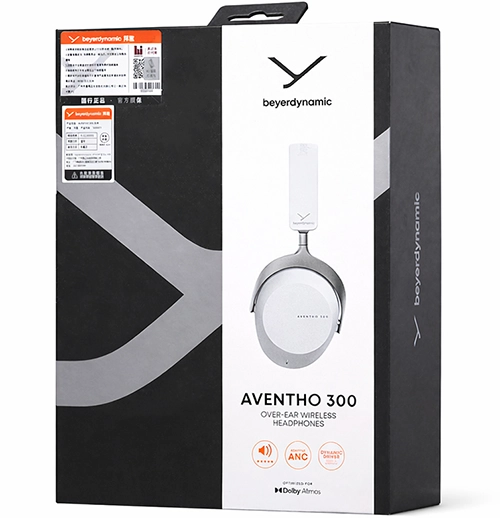
We don't mean to suggest that you should overpay for such packaging, but it's always unexpected and pleasant, and not all manufacturers provide it.

When you open the protective case, you will see the Beyerdynamic Aventho 300 headphones, which are arranged in a compact, acrobatic pose in their resting place. The hard case is of excellent quality, with a black exterior and a compact design. The inside is even more impressive. Not only does it have a soft lining, but it also contains a well-designed organizer that can secure the charging or AUX cable, as well as a small dongle or other small items. Two elastic bands divide the organizer into two separate parts, allowing you to customize the interior space.
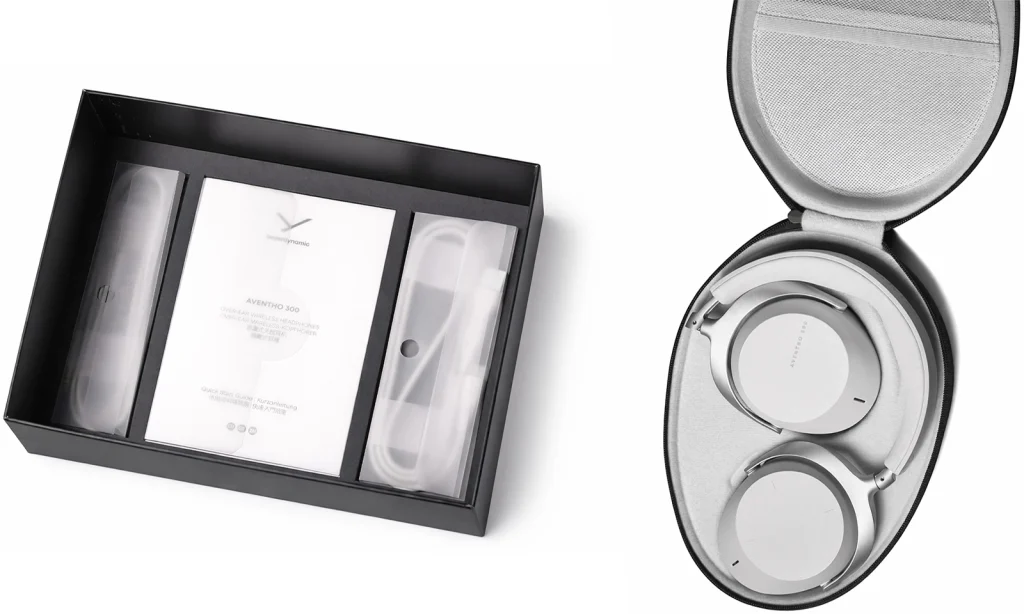
Of course, it also contains the Beyerdynamic AVENTHO 300 headphones. If you had any doubts about the quality of the materials or assembly, rest assured that this is Beyerdynamic; they can't afford to make "plastic" things, especially at this price. The metal headband and ear cup holders are cool to the touch. The headband and ear cups are made of durable plastic. The headband is covered in high-quality leather, and the ear pads are attractive. Everything is top-notch yet understated. The cups are densely insulated, and you can see the driver positioned at a slight angle to the ear.
We are pleased to inform you that this product is repairable, and we assume that finding spare parts in the future will not be a problem. It should also be noted that it is not difficult to disassemble them down to the last screw if desired.
The headphones are well-made and constructed from high-quality materials. They are also lightweight – at least they feel lightweight, despite weighing 319 grams – and comfortable to wear for long periods of time. Most importantly, the clamping force is just right so that your ears won't feel squeezed after wearing them for hours. Considering the headphones' dimensions, case, articulation when folded, and relatively low weight, as well as the comfortable clamping force, one thing is clear: Beyerdynamic wanted to make their device mobile first and foremost. The battery life also supports this assumption – 50 hours is an excellent indicator! The manufacturer recommends charging the device right out of the box, but we didn't see the point – the percentage refused to decrease while the headphones were in use. A polite young lady's voice kept saying, "Forty percent charge," in English when we turned them on. No matter how much we used them, the notification didn't change.
The sensor and control buttons are good. There are a sufficient number of them, but we personally prefer regular buttons to prevent accidental presses, track switching, and volume changes. We were also a little confused by the small size of the existing buttons. They are difficult to find by touch. You can get used to the ergonomics, but it was Beyerdynamic's design, not ours, so we can only note a certain… tension in the interaction. However, it is not critical.
These days, it's very easy to "hit the mark" with wireless headphones. All you need are headphones that don't have a control app and can't be updated with new firmware. That wasn't the case here, though. The box has a printed link to the app for your smartphone, and we recommend updating your headphones immediately after unpacking them. First, some features aren't available in the initial version "out of the box," and second, stable firmware always guarantees good battery performance and necessary bug fixes. Those who grabbed the initial firmware versions know what we're talking about.
First, the connection is excellent. It works well with smartphones, laptops of all models, and even the FiiO BT11 Bluetooth dongle. Remember that this platform is built around Qualcomm technologies, so it does not support LDAC. However, you can use all codecs from the aptX, AAC, and SBC arsenal.
In all scenarios, we experienced excellent signal strength and quality, as well as one annoying bug. Well, two bugs of the same nature, actually. However, they seem to be situational due to the circumstances of working with the dongle we were testing. We chose the FiiO BT11 because it is available. Second, not many devices support Aptx-Lossless, and this one does! Only devices with flagship Snapdragon Elite 8 series processors and anything newer support it, as well as a few dongles like this FiiO. We found it strange that the headphones seemed to reconnect every time a notification or audio started playing. During this time, a female voice in the headphones said "Aptx Adaptive" each time. Unfortunately, we didn't have the opportunity to test this on another device, such as a tablet or phone. Please take our experience into account. The same dongle worked flawlessly with other playback devices, so the initial nature of this bug remains unclear to us.
Another interesting finding was that, when we connected the dongle and headphones to a Windows laptop and selected a bit rate of 24/96 kHz in the device settings, the headphones constantly reconnected in a loop, similar to the bug described earlier. The sound was unstable and constantly interrupted. Switching the input device to 24/48 kHz mode prevented this problem. However, with the BT11 dongle and iPhone, everything worked fine until we turned on 24/96 kHz recordings, at which point we encountered the same reconnect loop. With a direct Bluetooth connection, the headphones worked perfectly.
The app itself is concise, easy to understand, high-quality, and effective. Considering the platform's potential capabilities, as well as those of competing apps, we expect the app to evolve in the future by adding broader functionality for interacting with headphones. The app is the hub for the company's devices, and you can connect all your Beyerdynamic headphones here. However, the company does not yet have many Bluetooth (BT) devices.
Now we come to the most important part/section of our Beyerdynamic Aventho 300 review. Of course, everyone wants to know what the headphones sound like. Everything is fine in that regard, but not as simple as we would like. You may not like the sound "out of the box." We personally had to adjust the equalizer, which was not ideal. Our attempts to create our own preset showed that the visual parameters don't clearly correspond to the sound. Moving these few frequency sliders up and down won't help you understand what's happening to the sound. You'll also notice a decrease in volume in the presets you've created. In other words, even if you start with a preset, you can customize it to your liking, but the volume of these settings will immediately decrease. Who came up with this, and why? One thing we were happy about was finding an EQ setting called "Loudness." We settled on it because of its fairly good balance and didn't change anything else. There were a few decent factory settings, but we weren't happy with the custom settings.

Finally, let's discuss the sound quality. These headphones are like excellent, full-size speakers! The instrument bodies sound natural and familiar, unlike the slightly weakened presentation of planar headphones. While these headphones aren't an exact continuation of Beyerdynamic's professional lines, they have noticeable similarities, starting from the very beginning of the range, which starts at 5 Hz and extends to the highest frequencies.
The bass is a massive and natural trump card in the frequency range, which has always been the company's signature feature. It's a wall of sound – a mass that presses when necessary and helps create depth of atmosphere. The beginning of the range is slightly softer than the neighboring frequencies, and this setting is consistently effective and charismatic. We would describe the sound as colored in a way that preserves the natural sound of instruments in the lower register. We'll call it expressive accentuation.

The company claims in its blog that these drivers outperform their classic counterparts in terms of efficiency. They claim that the drivers perform well, require minimal power, and produce minimal distortion, even at high volumes. It sounds good, but is this statement just marketing hype? Read on to find out…
The midrange frequencies are similar to those of typical U-shaped headphones. They are not flat, but slightly attenuated to emphasize emotionality. In this configuration, the top-of-the-line driver in the STELLAR.45 provides an extremely detailed picture, with one caveat: a shift toward emotionality. An audiophile experience with attention to detail should be provided by more stationary solutions, no matter how you look at it. Here, everything is geared toward making you want to dance or jump into the mosh pit when you hear your favorite music, whether you're listening to your favorite concert or cooking in the kitchen. These are clearly not conditions in which you will hear the details of the midrange and the tonality of the instruments. The voices are somewhat weaker in quantity but not in quality. There is a sea of details that are sometimes overshadowed by more massive emotional outbursts.
It's difficult to discuss the high frequencies here because, on the one hand, you immediately recognize the familiar peaks at 6 and 8 kHz typical of Beyerdynamic products. They may make you frown at first, but after a few minutes, you'll remember why you love Beyerdynamic. These headphones are designed to create atmosphere and mood, so the details in the high and low frequencies form the basic nuances of the space and stage. The stage is not super wide; it's a normal size. However, you will immediately believe in the reality of what you are listening to. You will hear spatial effects, reverberations, cymbals, bones, background noises, and audience coughs as if you were listening to your favorite recording from a new angle. It's also important that there are no gaps, a problem that even wireless headphones from renowned manufacturers often have. You may not be able to hear all these details on public transportation, at work, or on the street, but they are there, beautifully defined. Thanks to the stream of details provided by AptX Lossless, you will reach a new level of listening on the go.
Of course, we're not saying that you'll only use these headphones instead of your desktop to immerse yourself in your favorite worlds created by artists while sitting at home in your chair. However, if you're going for a walk, cleaning, commuting to work or school, or need to focus on a task for which music is helpful, the new Aventho 300 from Beyerdynamic is an obvious and excellent choice. They are full-size headphones with a good, true tonal balance, wide frequency range, and excellent ergonomics. After all, headphones should reproduce the original recording, not add to it. The Aventho 300s are a striking example of how not to spoil the material with a playback device.
We were interested in comparing these headphones with two models: the Audeze Maxwell, the gold standard for wireless detail that has blown everyone away for years, and the Sony WH-1000XM5, a mega-popular model. Audeze is a legendary company that opposes the mass market. They are still a niche company that only produces hits at a fairly significant cost. Sony acquired Audeze after they created the Maxwell model. Is this comparison fair and correct? Yes, absolutely. The price is the same, the goals are similar but not identical, and all models are iconic and important to their respective companies' lineups.

So, what about comparing the Beyerdynamic Aventho 300 vs Sony WH-1000XM5? The latter is an excellent tool for those who need to block out noise, focus on work in loud environments, or take a break from their surroundings, even while traveling on public transportation. The Aventho 300's active noise cancellation, which we didn't mention until now, is mediocre at best. They put slight pressure on your ears, but not like Sony's, which creates a vacuum around you. Beyerdynamic headphones focus more on music reproduction than noise cancellation. In our opinion, the Aventho 300's equalization is much more natural, and if the sound quality of the material is important to you, the Beyers handle it much better. This is due to small dips in the mid-high frequency ranges of the Sony headphones, which may not be ideal for those accustomed to a conventionally accurate sound. However, if ANC performance is important to you, Sony is the obvious choice. We apologize for comparing the WH-1000XM6 model to the previous model rather than to Sony's new release, as we haven't had the opportunity to evaluate it yet (update: 01/30/2026; We have tested the Sony WH-1000XM6 wireless headphones and written a detailed review of them).

The Audeze Maxwell headphones do not have active noise cancellation (ANC), but they do a pretty good job of blocking out noise passively. Their main problem, however, is their weight. The second problem is the planar driver. This is both a plus side and a downside. Planar drivers have a slightly different sound signature, so people who don't like it may not like Audeze's wireless hit from the start. The lower midrange and bass are slightly less natural and elastic on our favorite Maxwells than on the Aventho 300. Overall, the Audeze is more detailed and wins in some areas, while other material sounds much more natural on the Beyerdynamic. All of this leads to one conclusion: the quality of sound reproduction is comparable. Ultimately, you must decide which approach to sound reproduction is closer to your personal preference. However, the Beyerdynamic Aventho 300 has a significant advantage over the Audeze Maxwell due to its significantly lower weight, longer battery life, and greater portability. The new model is more mobile when folded, in a case, or on your head. It weighs almost half as much, yet the battery life is quite similar to the Maxwell's. You'll feel uncomfortable wearing the Maxwells outside in the cold or heat, but Beyerdynamic has made their chassis light, comfortable, and reliable.
Therefore, we cannot say that one of the three models is obviously better than the others. It all depends on your priorities and how you plan to use them. Personally, we would like to have wireless "planars" as well as dynamic headphones for when appropriate. Of course, weight is also an important factor in the decision.
We would also like to note that the Beyerdynamic Avento 300 belongs to the "AVENTHO" headphone line. This line includes two other models: the Avento 200 and Avento 100. Read our detailed reviews on these two junior headphone models at the link. There is no reason to compare the Avento 300, as it is far superior to the Avento 200 and Avento 100 in terms of sound quality and other parameters. The most interesting question is whether Beyerdynamic will expand this line of headphones in the future, and which devices are in store for us. Only time will tell...
Now that we've reached the end of our Beyerdynamic Aventho 300 review, it's time to summarize the results. Dolby Atmos Head Tracking is, of course, an important part of the Aventho 300's specifications. However, during our review, we didn't pay much attention to Spatial Audio technology, a competitor to Dolby Atmos Head Tracking. Understanding the device's basic capabilities was much more important to us. Thus, factors such as Bluetooth 5.4's technological capabilities, battery life, ergonomics, frequency settings, and driver speed are much more important in forming an opinion about the headphones. However, we must admit that these headphones' technological richness is impressive, and all of their features, except for Head Tracking, are functional and necessary.
The wonderful unboxing experience was complemented by the impression of holding a well-built product made of quality materials with an excellent set of accessories. Then, it turns out that the company has also done a great job with the sound! We didn't expect much but hoped for the best. This time, we didn't read any reviews before writing our own so as not to have a preconceived opinion. We were pleased that Beyerdynamic not only pleased us but also impressed us.
Yes, Bluetooth headphones and audiophilia are still not entirely compatible, but we don't know how we would manage without this form factor, which allows freedom of movement without sacrificing sound quality. Now, even less than ever! These are remarkable headphones, and our editorial team at SoundGale.com sincerely recommends that you check them out and purchase them.
We hope you enjoyed our review of the Beyerdynamic Aventho 300 headphones. Please feel free to leave your comments, questions, and suggestions in the section below. We will be happy to answer them all as soon as possible. If you already own an Aventho 300 and have used it for a while, don't forget to share your impressions and tell us what you liked or disliked about these headphones.
Pros
|
Cons
|
9.8
/10
Our Score
|



Thanks for highlighting the repairability, as incredible as this seems even high end equipment became throwaway items once the battery is gone.
It is mentionable too that a device made in Europe can resist against chinese production.
Great review guys