Today, we are going to review the FiiO JT7 planar magnetic headphones, also known as the Jade Audio JT7. These headphones excel in many ways, so in our review, we will examine all their features and discuss their sound quality. The FiiO JT7s are attractively priced, open-back planar headphones from the budget sub-brand Jade Audio. They were made in collaboration with the parent brand, FiiO Electronic Technology Co., Ltd. The manufacturer opted for an open-back design and used planar magnetic drivers, which should provide deep bass and a wide soundstage, attracting attention with unusual features, such as a full folding mechanism and a balanced cable included in the package.
FiiO has changed the paradigm of high-quality sound costs by releasing the cheapest full-size planar headphones with their own driver design. Regardless of skepticism, the FiiO x Jade Audio JT7s are very good, so let's take a closer look at them. As usual, we will begin our review of the FiiO JT7 with the specifications to get a better understanding of this device.
|
Best Price on FiiO JT7
The FiiO JT7 are open-back, over-ear planar magnetic headphones designed to bring true planar performance to a much more accessible price tier than most competitors. |
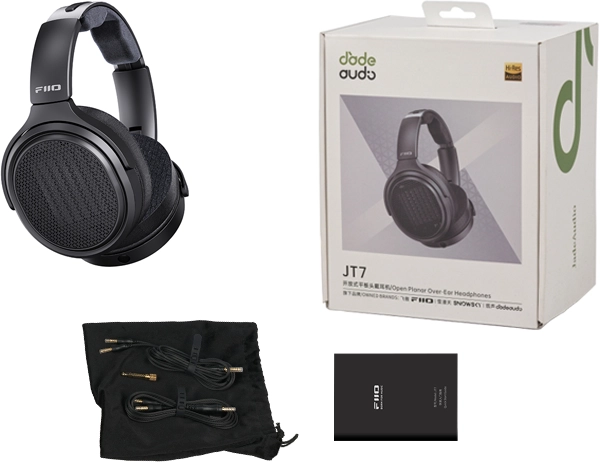 Classic Package
|
In an effort to minimize costs, FiiO abandoned the standard packaging for the FT models and packaged the headphones in a plain white box with printing. The first thing that catches the eye is how compact it is. This was achieved thanks to the headphones' foldable design. The second thing that was given up was the hard case. Instead, there is a simple bag for storing the headphones. However, it will only protect them from dust. They did not skimp on anything else. The headphones come with two cables: one with a standard 3.5mm connector and the other with a balanced 4.4mm connector. Everything is the same as the FiiO FT1 Pro model; the only difference is that the cable is insulated with regular silicone instead of hard fabric. The plugs are the same as those used on the FT1 model, so there are no complaints about the quality of the connectors.
They also included a 3.5-to-6.3-millimeter adapter. Overall, this is an extensive package for the price. As mentioned above, the package includes two cables. They connect to the headphones via standard 3.5mm connectors on each ear cup, so the cables can easily be replaced if desired. The cables are acoustically high quality, and we did not notice any problems. Replacing the cables with FiiO FT1 cables did not change the sound. The connectors are high-quality with a good coating, so they should work well. We liked the interesting cable insulation – it is not smooth, but ribbed, and these ribs actually add strength to the cable, which will have a positive effect on its resistance to bending and other factors.

Moving on to the headphone ergonomics, we want to start with the earpads, because they are modified ear pads from the FiiO FT1/FT1 Pro series. Firstly, they are attached with plastic clips (as stated on the website, they are replaceable), and secondly, they are the same hybrid ear pads made of leatherette and perforated fabric, but unlike the FT1, the leatherette side of the ear cushions has also been perforated. We cannot say how this affects the sound because the earpads are not compatible between FiiO headphone models, and it was not possible to compare them.
Now, let's talk about the headphones themselves. The FiiO JT7 is primarily made of plastic. There are two reasons for this: price and manufacturing cost. Foldable plastic headphones are simply cheaper to manufacture. The second reason is to reduce weight, as planar drivers and magnets are quite heavy. However, plastic isn't the only material used. The headband is made of metal to provide better control over the clamping force and greater durability. For comfort, two soft pads are placed on the headband. They are replaceable and distribute the weight well, allowing the headphones to sit comfortably on the head.

The ear cups are made entirely of durable plastic, yet the outer grille feels like metal to the touch. Hidden underneath is FiiO's proprietary planar magnetic driver. We liked that the distance from the transducer to the outer grille is quite large. Even if you accidentally bend it, it will most likely not come into contact with the transducer. This is a significant advantage because complex headphones can end up in a bag where they could be pressed against something.
Another interesting feature is that the headphones (earcups) are completely transparent. If you look through them, you can see your fingers resting on the outer grille from the side of your ear.
Similarly, the official FiiO website states on the product page that the folding hinge components are made of high-strength fiberglass. According to the website, this material significantly extends the service life of the headphones compared to plastic hinges.
So, we've reached the most important section of our FiiO JT7 review, and now we'll talk about the most crucial aspect in headphones – the sound. It is provided by a new 95x86 mm planar driver developed by FiiO and two magnetic grilles. In terms of sound signature, the FiiO FT1 Pro and the FiiO JT7 have similarities. Both are warm, musical, and straightforward headphones. Despite differences in transducer and construction design, we found no difference between these two models. In fact, we got the impression that we could copy the FT1 Pro description and it would accurately describe the JT7's sound. We'll discuss that in the section below. First, let's focus on the JT7's sound signature.

Overall, the sound of the JT7 is absolutely flat but not neutral. After using V-shaped headphones, the JT7s may seem bright at first, but this is purely psychoacoustic. Once your ears adjust, the sound starts to feel flat and somewhat muddy. This muddiness isn't due to a lack of resolution or detail; it's caused by the absence of a frequency response dip in the 500 Hz range. As soon as you lower the equalizer slider, the muddiness disappears, and the midrange contrast emerges. We encountered the same effect with the sound of the FiiO FH1s, which are also practically flat in the 100–1,000 Hz range, just like the JT7.
Upon closer inspection of the sound frequencies, it's clear that the low frequencies are not quantitatively emphasized here. However, they reach maximum depth despite the decline in the lowest bass range. The control and detail are simply excellent – the planar driver in all its glory. Despite the lack of emphasis, the sound is not dry; the impact is present, and the weight distribution is good. Of course, you shouldn't expect the same level of bass as with consumer headphones, but the JT7 can produce dense sub-bass, juicy mid-bass, and precise, controlled upper bass.
Additionally, the FiiO JT7 does a good job of differentiating instrument textures and pulling out reasonable dynamics. However, it's far from the speed of high-end headphones, even though it's planar. However, we expected a larger difference compared to more expensive FiiO planar headphones, such as the FT1 Pro or FT5. The bass kept up with the music and was engaging, but we missed some detail and emphasis in the lower range. However, this is all subjective to one's taste. As a result, we enjoyed listening to jazz, blues, rock, electronic music, and metal, and we juggled not only albums but also genres, all of which the FiiO JT7 can handle. Overall, we would describe the low frequencies as very good, with only minor complaints considering the headphones' price. Simply put, there is enough bass for open planar headphones.
The midrange frequencies build on the lower frequencies, offering a natural and direct reproduction of instruments and vocals. They are smooth with good detail. There is a slight rise in the 1-4 kHz range, but no emphasis on the high frequencies. Therefore, while the headphones are not bright, they may feel that way at first. The low range is present, frequencies around 1 kHz sound undistorted, and the higher range appropriately illuminates the music. However, the scales tip toward musicality rather than analyticality. There is a hint of warmth, smoothness, and softness.
The midrange is still well-defined and accurate, with no muddiness or muffledness. It's just that the presentation is neither aggressive nor overly technical. Thus, we can break down compositions into their constituent parts, catch details, and relax with the music in the background. While testing the FiiO JT7, we also used it for gaming, which is uncommon in the world of planar headphones. Gunshots and other sharp sounds are often hard to tolerate, but not with the JT7. We had no complaints in this regard.
High frequencies – once again, we have exemplary planar HF. It's not overly expensive, and even disregarding the cost, the average length and precise HF attacks and decays create a moderately airy sound. All high-frequency instruments sound natural without excessive sharpness. The upper part of the range is not separated from the middle range. It does not seem overly emphasized, but has not been cut or darkened either. Thanks to this, you feel close to the music. The headphones do not emphasize sibilants or hurt your ears, and the sound remains accessible.
We like this setting because many planar headphones sound sharp, making it difficult to listen to albums with poor recording quality. This is not the case with the JT7. Only the most demanding listeners will be disappointed because the high frequencies are not perfectly natural or selective. For example, the cymbals have a slightly sandy quality and are not as sonorous or metallic as one would like. However, you can't have everything at this price.
The headphones are completely open, which creates a fairly good imaginary soundstage. However, it's not that simple. We would describe the soundstage as intimate rather than large. The instruments are clearly separated and positioned without blending or dispersing at the edges of the stage. With balanced connections, you can expect wide stereo imaging and contrasting channel separation, which positions the instruments on the sides. However, the depth and height are unimpressive; the stage is shaped like a flattened ellipsoid, and not much happens on the front-back and top-bottom planes. Therefore, it is impossible to call the soundstage three-dimensional or to admire the varied exposure of apparent sources. Nevertheless, the music is not overwhelming, and the soundstage does not cause claustrophobia.
During the testing and writing of our FiiO JT7 review, our entire SoundGale editorial team listened to this headphone model. Most of our team members described the soundstage and sound reproduction as more monitor- or studio-like than spectacular or concert-like. This is likely because our editors have extensive studio experience and expertise in sound engineering. They have a good ear for audio equipment, which is why they described the soundstage this way. However, it's important to note that the FiiO JT7 is not very suitable for studio work.
The FiiO FT1 Pro planar headphones can be considered the main reference for comparison. Both models have similar characteristics: an open-back design; large planar transducers; and a symmetrical cable connection. Is FiiO shooting itself in the foot with the $120 JT7 model? Or is it worth paying extra for the FT1 Pro ($200)? Let's figure it out.

Interestingly, the FiiO JT7 has some advantages over the FT1 Pro. The hero of this test is lighter, at 318 g versus 375 g, and it is fully foldable. This is a rare feature in stationary headphones, especially planar ones. So, what's the catch?
Attentive observers will notice that the JT7 model uses transducers manufactured using the same technology (28 nm), but with thicker 3-micron membranes than the FT1 Pro, which has 1-micron membranes. This could mean lower dynamics and poorer sound resolution. Other cost-cutting measures are evident as well: the absence of an aluminum-sapphire coating on the membranes, a simplified headband, lower-quality construction materials, and non-silver-plated cables. However, these differences can be overlooked when considering the price difference – the JT7 is $80 cheaper than the FT1 Pro.
Now, let's examine them from a sound quality perspective. Both models offer heavy bass, warm midrange frequencies, and clear high frequencies. The sound of both models can be described as naturally balanced. We didn't notice any significant differences in dynamics or resolution. The FiiO JT7 keeps up with the attack and conveys a lot of detail; it definitely doesn't get boring.

However, this does not mean that the FiiO JT7 sounds identical to the FiiO FT1 Pro. In our opinion, the JT7 headphones produce slightly more bass and extend further into the sub-bass range. We perceived the low frequencies of the JT7 as slightly more substantial, which further warmed the sound and softened the high frequencies compared to the FT1 Pro. The more expensive planar headphones also create a slightly wider soundstage, though neither the JT7 nor the FT1 Pro boasts depth.
Therefore, if a slightly wider soundstage, more contrast in sound, better build quality, and a more neutral sound are important, then the FT1 Pro may be more appealing than the JT7. Consequently, we recommend the FT1 Pro for studio tasks and the JT7 for everyday multimedia tasks.
Now, let's address the main question: Is it worth paying an extra $80 for the FiiO FT1 Pro? Yes, if you need headphones for studio work. For example, you might use them during the day for multimedia activities like listening to music, watching movies, and gaming. In the evening or when inspiration strikes, you can use them to write tracks in your favorite digital audio workstation (DAW). The FiiO FT1 Pro also comes with a higher-quality hard case for storing and transporting the headphones, as well as higher-quality materials and cables. As a result, the sound quality is slightly better. However, if sound quality is your main interest, we recommend coming to the store and listening to both the FiiO FT1 Pro and the FiiO JT7. We favor the FiiO FT1 Pro in this comparison, but we don't underestimate the JT7. If you have a limited budget or find the JT7 on sale, buy them.
We would like to remind our readers that we have a separate detailed review of the FiiO FT1 Pro planar magnetic headphones. You can read this review to help you make a more informed decision about these headphones.
Finally, we've reached the end of our FiiO JT7 review, so it's time to summarize the results. The FiiO JT7 (Jade Audio JT7) exceeded our expectations. Although we anticipated having to make many compromises compared to the FT1 Pro model, these less expensive headphones are almost on a par with them. Furthermore, the design is now lighter and foldable. At $120, you get lightweight, comfortable, planar magnetic headphones that produce a direct, clear sound with a warm, natural quality. The bass is decent, the mids are close and the highs are clean but not harsh. This makes the JT7s great for both music and gaming.
However, there are some drawbacks. The build quality is unimpressive – plastic materials predominate and the design seems unstable. The size adjustment range is wide, but it is excessive – people with smaller heads may complain. Don't expect an impressive soundstage, outstanding dynamics or high-quality detail.
We really enjoyed testing them, and although they are far from perfect, the price-quality ratio is extremely favourable. We believe these headphones are definitely worth recommending, especially if you're looking for planar magnetic headphones with smooth high frequencies. If you don't mind the amount of plastic in the design, we highly recommend giving them a try.
We hope you enjoyed our review of the FiiO JT7 open-back planar magnetic headphones. Please feel free to leave your comments, questions, and suggestions in the section below. We will be happy to answer them all as soon as possible. If you own the JT7 and have used it for a while, please share your impressions and tell us what you liked or disliked about these headphones.
Pros
|
Cons
|
8.0
/10
Our Score
|