Today we will review the premium Beyerdynamic DT 1770 PRO MKII and DT 1990 PRO MKII studio headphones. Let's take a look at why these two updated headphone models are a small step for the company, but a big step for all consumers. You're probably wondering why we were so bold as to call this update insignificant for the company from the outset. Here we have a completely redesigned driver (yes, sarcasm, because it's the only one for both models) TESLA.45 and… What else? - That's it!
You can search for other physical differences from the first generation of headphones, but you won't find them right away. The main change is in the approach. It's not that we can't appreciate the work Beyerdynamic has done on the sound, it's just that these models already sounded great in the first generation. However, people who have been observing the market and sound trends for years only evaluate the work done to correct mistakes and the specific results. And here we should be surprised not by the improvement in sound, but by the significant and very important changes in the positioning and flexibility of the new generation DT 1770 PRO MK II and DT 1990 PRO MK II.
|
Best Price on BBeyerdynamic DT 1770 PRO MK II
The Beyerdynamic DT 1770 PRO MK II headphones are a compelling choice for professionals and enthusiasts seeking a detailed and neutral listening experience in a closed-back form factor. |
 Pro Plus Package
|
|
Best Price on Beyerdynamic DT 1990 PRO MK II
The Beyerdynamic DT 1990 PRO MK II are premium, open-back, studio reference headphones designed for professional audio work including mixing, mastering, and editing. |
 Pro Plus Package
|
The Beyerdynamic DT 1770 PRO MK II and the DT 1990 PRO MK II have essentially identical specifications since they both have the same TESLA.45 dynamic driver. The only difference is that the DT 1770 PRO are closed-back headphones and the DT 1990 PRO are open-back headphones. Furthermore, there are a few slight discrepancies in the headphone accessories, particularly with regard to the additional earpads. Does this difference affect the sound? Read our review below to find out.
Beyerdynamic DT 1770 PRO MK II
|
Beyerdynamic DT 1990 PRO MK II
|
Both models have almost identical contents, making the package easy to navigate. Similar to the first generation Beyerdynamic DT 1770 PRO and DT 1990 PRO, the headphones come in a cardboard box with a hard case and the usual paperwork that no one reads for at least a year. The case contains all the accessories: two detachable cables (one twisted up to 5m long and one straight 3m long) with 6.35mm jack adapters already screwed in, the headphones themselves, and an extra pair of ear pads. While the 1990 model had just an extra pair of identical velour ear pads, the 1770 model has a second pair made of leatherette. This is important from a functional point of view, which we will discuss later.
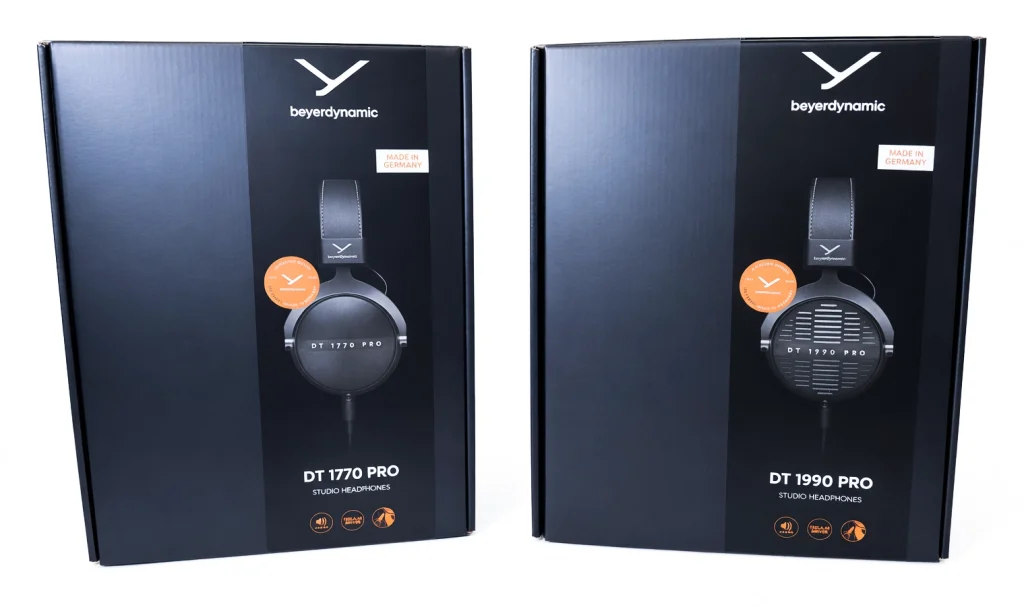
The cables are excellent quality, and it's great that you can choose separate cables for different usage scenarios. We have long discussed the need to switch all Beyerdynamic models to detachable cables, but this luxury is only available in newer models.
The hard case is also of very good quality. It's great that the external density is the result of fairly good internal formation for the headphones. Such cases usually protect expensive headphones much better in suitcases, on the back seat of a car, or from children. Inside the case, there is a zippered pocket for cables that is attached to the inside with Velcro.

The ear pads are pretty straightforward. They feature the brand's signature comfortable velour, which significantly increases comfort. The construction of both models, both in the previous generation and in the update, is the same and raises no questions. The materials are high-quality and pleasant to the touch. We can even note that in terms of comfort, it has become better than in more affordable models, and this trend exists in both the previous iteration and the update. All materials are very pleasant to the touch, and you can feel the brand's durability and reliability.
During testing, we were able to wear the headphones comfortably for hours because the clamping force is adequate and the weight is not excessive. However, it should be mentioned that this review is being written during the cold season. In warm or hot weather, the design may cause excessive heating over time, which could be uncomfortable. But this is old news, the flip side of the same velour brand ear pads. The main fit is just excellent!
Now we come to the most important part/section of our Beyerdynamic DT 1770 PRO MKII and DT 1990 PRO MKII review. Of course, everyone wants to know what the headphones sound like and what has changed compared to the previous generation. The updated Beyerdynamic DT 1770 PRO MK II boasts the most significant sound improvements. While the previous generation had almost no sonic similarities between the 1770 and 1990 models (except for the oversaturated high frequencies), it is now clear that they are from the same line and have a lot in common. First and foremost, both models attenuate aggressive highs. Yes, there is still some saturation at 8 kHz, but the neighboring ranges are slightly lower, and the raised upper frequency range of the dynamic driver is exemplary. This feature works well and is exactly what the company needed. Although there is not much competition in the above-average price segment, you can't afford to have a product with obvious defects that prevents you from using headphones at high volume levels, which is necessary in any field of application. In other words, the main focus and generic features are still there - this is Beyerdynamic's trademark - but at some point, it became necessary to understand that certain requirements exist and grow over time. If competitors are trying to improve, then you need to stay on your toes. You can't run a business on fan loyalty and re-releasing old hits alone.

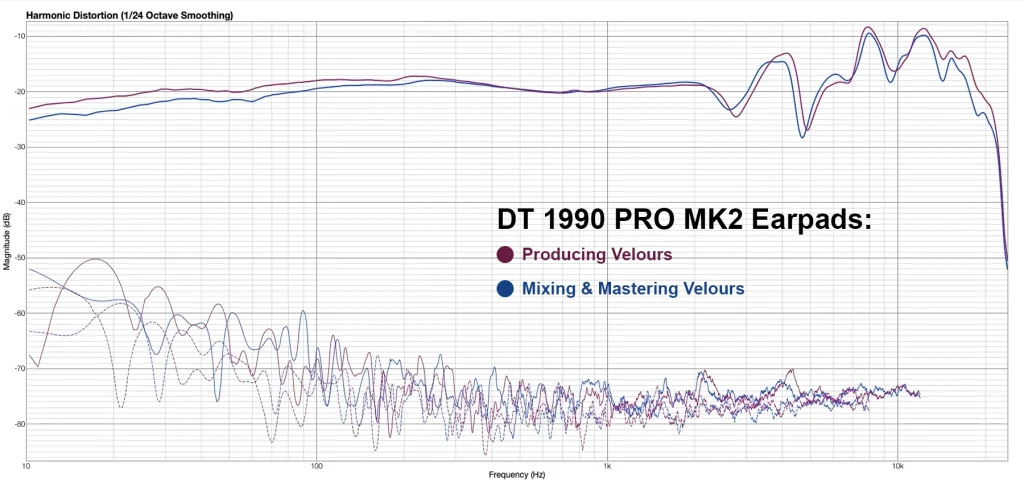

The differences in the high frequencies remain to be mentioned. Due to the Beyerdynamic DT 1770 PRO MKII's closed-back design, we hear high frequencies louder in certain places. However, the laws of physics cannot be overcome, so mixing certain frequencies results in slightly less detail and more frequency conflicts than with open-back headphones. However, this is simply a fact of life with this form factor. The overall resolution is very, very high, and here we are talking about a completely different level of understanding of spatial effects, a completely different experience of music as a whole.
The midrange of both models is quite similar, the driver works well in this range, but due to the slightly embellished treble, you sometimes get distracted by the Beyerdynamic DT 1990 PRO MKII, and the DT 1770 PRO MKII has some midrange shadowing (like the classic 770 model at 250-300 Hz), though not as significantly.
And then there's the bass! From the first few seconds with the DT 1770 PRO MKII, we recognized its kinship with the DT 770 PRO. It's impressive and exciting. Imagine that the frenzied punch and massiveness have been slightly tamed for the sake of detail and driver control. This allows the midrange to articulate much better than in the younger models. The new driver is also much faster. It turns out that the new generation of the DT 1770 PRO has it all, with only the minor features described above in the paragraph about midrange frequencies.
The DT 1990 PRO MKII model plays in a different league here, i.e., it has a different ideological focus, and its competitors in this segment are primarily highly detailed and natural-sounding headphones. This is where the other side of the new TESLA.45 driver comes into play - with less bass massiveness, it clearly reproduces everything in the recording up to 1.5 kHz. There is no point in talking about the need for isodynamic drivers when the wavelengths up to this range are significant enough and do not require excessive speed and number of vibrations to reproduce them. In other words, the bass range plays very detailed, fast, and with a natural timbre.
Well, here's the most interesting thing that happened in the changes to the MKII models. How did Beyerdynamic realize the need to reduce resistance in their headphones/drivers? Is the new driver design and wiring a response to sales, or just new faces on the team, or competitor analytics? We can guess without ever knowing the truth, but the most important thing is the result. And as a result, we all got incredible flexibility, because 30 ohms of resistance is simply an incredible trump card that Beyerdynamic pulled out of its sleeve. Just imagine – laptops, mobile phones, tablets, audio interfaces with low-power headphone outputs – all of this and everything else mentioned above will rock these headphones, and you can listen to your favorite music or do any level of production on the go, anywhere (from a hotel room to the subway). Video, sound design, gaming, sound recording, and music production of the highest level are now available on the go, in a case ready for transport. Of course, we need to take a breath when such phrases appear, but this is no exaggeration. Remember how many people you've seen on the streets with completely non-portable DT 770, Sony MDR7506, Audio-Technica ATH-M50x? Many of these people had no other choice, i.e., they know what good sound is, and compromises in convenience are not scary for them. Yes, this scenario is not for everyone, but it serves as an example of how Beyerdynamic is targeting your wallets and taking modern challenges very seriously.
Many gamers and streamers had trouble with their DT 990s due to significant overhype in the high frequencies and low volume of their weak audio interfaces – but now you don't have to compromise on anything! Of course, the price tag is significantly higher than that of the 32 and 80 ohm versions of the main line. Before, there was no point in paying more for better sound because better sound required significant amplification. Now, however, there is definitely a point, and we can recommend the updated models as the next step in improving any setup. Both models perfectly convey the footsteps of opponents in shooters such as CS 2, as well as sound effects designed to increase your immersion in the game. You'll feel like what's happening on the screen is real.
When it comes to listening to music, these models' flexibility eliminates the need for powerful devices. The only requirements are the minimum necessary and the quality of the DAC chip. These headphones essentially transmit the signal clearly, making it easy to hear any playback flaws. But times have changed. Thanks to significant competition, it's now easy to find a high-quality dongle amplifier that reveals the full potential of these models. It works with PCs and Macs without the need to install an additional control driver. If you asked us personally which model we would choose for listening, we would choose the DT 1770 PRO MKII because it seemed more "fun." It's a leap forward from the DT 770 in terms of detail, quality, and authenticity. The Beyerdynamic DT 1770 PRO MK2 has a very clear sound with big, massive bass and beautiful, non-stuffy highs, so it has every chance of winning your love. This choice is more obvious for owners of neutral equipment.
For fans of "warm tube sound," we recommend paying attention to the DT 1990 Pro MKII. These headphones are for you if you don't need to isolate yourself from the outside world (and vice versa), if you like to sit down in your chair with warmth in your heart after wiping the dust off your turntable and amplifier, and if you enjoy listening to your equipment. Thanks to the accurate frequency response, their detail clearly conveys the characteristics of the equipment, and the saturation of any device will be very audible. The DT 1770 PRO MKII is also suitable for this purpose; since much equipment already has enhanced bass, it may not be the best combination. However, it may be worth a try.
As for the professional use of these models, the reduction in saturation at the top end benefits only those who have chosen to purchase the updated series. The Beyerdynamic DT 1770 PRO MK II is ideal for monitoring guitar and vocal recordings with condenser and dynamic microphones, as well as controlling volume levels. But remember one important detail - the additional leatherette ear pads! If you think they improve sound quality or functionality, you're mistaken. They improve sound insulation during recording and tighten the fit. This is necessary when recording drums because the drummer moves around quickly. There are microphones set up around the room: one above, one for the toms, one for each drum where needed, one for the snare, one for the kick, etc. - and this whole setup picks up the slightest rustling sound. With compression, all the necessary and unnecessary sounds only increase in volume, and what will we hear first? The clicks of the metronome in the drummer's headphones)) Yes, this has already let down many amateurs and professionals, which is why the DT 770 version with leatherette ear pads is so necessary and indispensable in this scenario. But wait, now you have the opportunity to get the right ear pads for your drummer and… He no longer has any excuses not to play his part for the recording! And with the best sound quality possible in this segment of devices.
Based on our extensive studio recording and audio engineering experience, we would not say that the DT 1770 PRO MKII is suitable for mastering tracks. This task requires open-back headphones. However, the DT 1990 PRO MKII is quite suitable for mastering. This is one of the few tasks that requires at least one more pair of headphones for midrange monitoring (for example, Sennheiser HD 600/650, Audeze MM-100). In principle, there are only a few pairs of headphones in the world that are fully suitable for mastering at the moment, and they are not very flexible in other areas of use. The new 1990s are not suitable for recording in pair with condenser microphones because sound leaks (bleed) from the partially open design to the sensitive mic's diaphragm. But everything else related to production is their forte, the strong point of this model. An excellent tool for controlling volume levels, compression levels, equalization accuracy, and mixing material. When it comes to video production, there's no reason to talk about studio monitors when headphones like these exist. We sincerely recommend the Beyerdynamic DT 1990 PRO MKII for video production tasks!
Now, let's summarize the "Fields of Application" section of our Beyerdynamic DT 1770 PRO MKII and DT 1990 PRO MKII review. According to the manufacturer, Beyerdynamic, on its official website: The DT 1770 PRO MK II is suitable for recording, monitoring, and editing, and the DT 1990 PRO MK II is suitable for mixing, mastering, and editing. We can confidently confirm that this statement is entirely justified.
And don't forget that mixing and mastering with headphones is not the best idea. For these purposes, there is almost no alternative to good studio monitors. The fact is that headphones cannot fully convey the panorama in the mix, and mixing & mastering with headphones requires a lot of studio practice. You have to spend a lot of time with a specific model of headphones, constantly comparing the sound of the mix with studio monitors, in order to develop an understanding of how your headphones convey the panorama.
We do not underestimate the importance of studio headphones. They are an essential tool for monitoring and recording. They are also an excellent option during the compositional stage of creating a track. If you have a home studio, for example, and inspiration strikes late at night, headphones are the best solution if you don't want to disturb your neighbors or family members with the volume of your studio monitors. The next day, you can use studio monitors to tweak your mix or master your track during the daytime.
Let's start with a simple logical conclusion: The existence of the MK2 models spells doom for the previous generation because the manufacturer has acknowledged the need to update and improve certain aspects of the previous generation. The old series is ideal for professional tasks such as determining excessive low and high frequency saturation, and it is a good choice if you have a device that can drive fairly tight 250 ohm headphones.
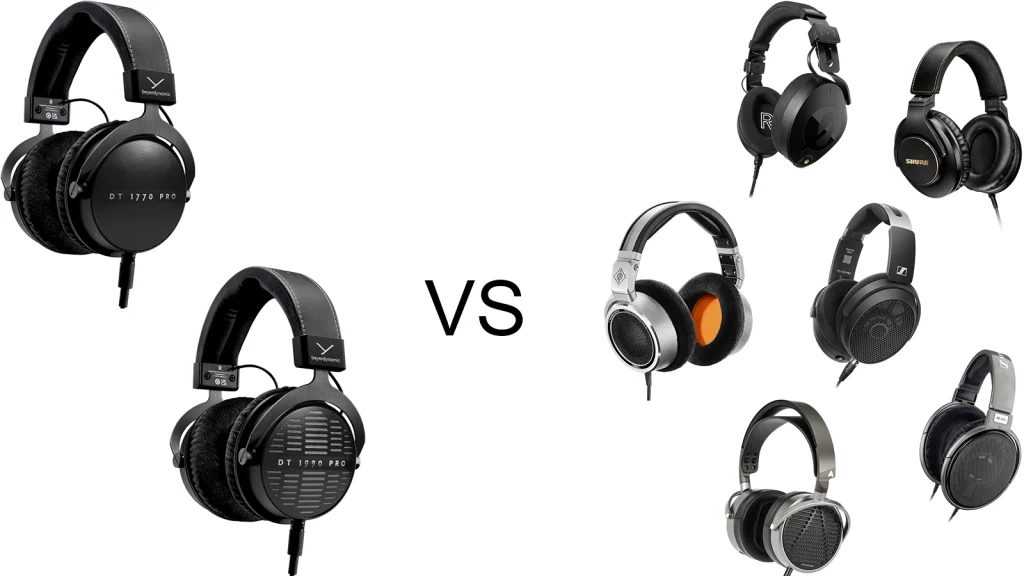
Regarding the Beyerdynamic DT 1770 PRO MKII, we believe the DT 770 was previously one of the best studio recording tools. However, time and stagnation showed competitors needed to take action. Enter the Rode NTH100 and the Shure SRH line of headphones, which we recently reviewed. Taking these competitors into account, the 770s are no longer the obvious choice in some respects. But imagine the 770s with fewer frequency response issues, better connection flexibility (there was flexibility, but the 32 Ohm models were not for people who were serious about sound quality), and an ultra-fast dynamic driver with superb detail. All this comes with a detachable cable and an excellent accessory kit! It's a hit - it's a treasure - it's the DT 1770 Pro MKII. If the price range doesn't deter you, and you realize that you may have to save up for a while but want to make a one-time purchase that will last a long time without the need for upgrades, this is the choice for you.
From an audiophile's perspective, the Beyerdynamic DT 1990 PRO MKII is undeniably excellent. Imagine an audiophile who is satisfied with just one pair of headphones! This model deserves a place in your collection. You may not need to upgrade from the first version to the second if you're using them in a stationary setting, but if you want a portable option, this is our sincere recommendation.
From a professional standpoint, there aren't that many competitors for the DT 1990 Pro MKII. The Audeze MM-100, the Sennheiser HD 490 PRO (we have a comprehensive and detailed review of this headphone model), the Sennheiser HD 650, and the Neumann NDH 30. That's it. The Neumann NDH 30's strength lies in its nearly perfect reproduction of the entire frequency response range, making it accurate, which is important in the final stage of sound production, mastering. It is the only competitor that can perform all professional tasks, but it is not ideal for listening to music. Many of us are accustomed to rich sound, and conditional accuracy is not for everyone. Sennheiser comes close for mixing tasks, but the HD 650's lack of strong bass and lower driver speed (and therefore detail) puts it out of the game. It's on a different level. They also lack flexibility in terms of the power sources they can be used with. The Sennheiser HD 490 PRO is a very flexible model, but its detail speed is slightly inferior to that of the DT 1990 Pro MKII. However, the HD 490 PRO can perform all the same tasks as the DT 1990 Pro MKII. The 490s' power sources, with their 120-ohm impedance, must be good but are unfortunately not portable. The Audeze MM-100 is an excellent tool, but it falls short of the DT 1990 Pro MKII in terms of bass feel and balance. The Audeze MM-100 has a midrange focus and the tasks assigned to it are identical to those performed by the second-generation DT 1990 Pro model – it is a very powerful model, but with a different presentation. Importantly, the MM-100 can be used with portable players, laptops, and smartphones.
Now that we've reached the end of our Beyerdynamic DT 1770 PRO MKII & DT 1990 PRO MKII review, it's time to summarize the results. We constantly think about how easy it is to review devices, headphones, and gadgets that we personally like. We're not sure if we've mentioned this before, but it's always on our minds. The Beyerdynamic DT 1770 Pro and 1990 Pro MKII are exactly the kind of devices we "personally like". They have no noticeable flaws. They are better than previous models and their competitors. They are impressive! Finally, Beyerdynamic has moved away from its principles and traditions toward modern trends. While not much has changed in the context of the product line (objectively speaking), a lot has changed in terms of what the consumer gets. We would like the company to continue working on developing its lines, and today it has finally become clear that we see how the buyer is taken into account, and we will continue to support this approach in the future. In the meantime, we have excellent and very successful models – so similar to each other and so necessary for many of us.
We hope you enjoyed our review of the Beyerdynamic DT 1770 PRO MKII & DT 1990 PRO MKII headphones. Please feel free to leave your comments, questions, and suggestions in the section below. We will be happy to answer them all as soon as possible. If you already own a DT 770 PRO MKII or DT 1990 PRO MKII and have used it for a while, don't forget to share your impressions and tell us what you liked or disliked about these headphones.
Pros
|
Cons
|
9.7
/10
Our Score
|