Today we are going to review a rather interesting audio interface, the Arturia MiniFuse 2 OTG, developed in 2025 by the French company Arturia and aimed at the rapidly growing market of bloggers and streamers. It is the simplest and most affordable product for the mass market, offering the most popular combination of 2 inputs and 2 outputs. What makes the Arturia MiniFuse 2 OTG special? As the name suggests, the device has not one, but two USB ports, the second of which is called OTG (on-the-go) and is designed for connecting mobile devices.
The manufacturer promises that the MiniFuse 2 OTG will transform your smartphone into a portable recording studio, enabling you to produce music on the go. You can produce high-quality content directly on your smartphone without connecting a laptop. However, when connected to a PC, you can redirect the audio stream between devices. For example, you can use your laptop for your usual Ableton session and stream live to the internet via a smartphone app. The Arturia MiniFuse 2 OTG retains all the advanced features of the Arturia MiniFuse line of interfaces, including extended audio monitoring in headphones or speakers with an adjustable balance between inputs and backing tracks.
The Arturia MiniFuse 2 OTG includes all the features of the popular Arturia MiniFuse 2 audio interface, plus an additional input for streaming, several virtual devices, and routing support in the MiniFuse Control Center control panel. The manufacturer offers detailed instructions in PDF format and tutorials on YouTube for those who are unsure about how to use it. However, we will also test and discuss all the features of the Arturia MiniFuse 2 OTG in our review, but before we move on to the main sections, let's take a look at the specifications of this device.
|
Best Price on Arturia MiniFuse 2 OTG
The Arturia MiniFuse 2 OTG is a well-rounded, portable audio interface that stands out for its mobile connectivity and creator-centric features. |
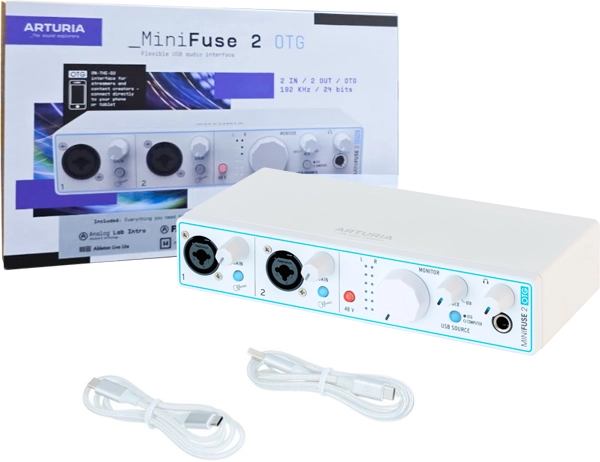 Classic Package
|
Line Inputs
|
Instrument Inputs
|
Microphone Preamps
|
Speaker Outputs
|
Headphone Out
|
OTG
|
Its appearance is identical to that of other models in the MiniFuse line. The only difference is that the Direct Monitor button is missing. Monitoring is always on and controlled by the MIX knob. The button has been replaced by a USB source selection button: OTG or COMPUTER. Although the photo may make it appear as if the case is plastic, it is actually metal painted white. Therefore, there will be no reliability issues.

The XLR/TRS inputs are located on the front. Phantom power is applied to both inputs simultaneously. The knobs are backlit. The colors indicate the following for the inputs: blue for signal present and red for overload. There is also a multi-segment LED level indicator. It's great that the level can be adjusted separately for the speakers and headphones.
The technical specifications are identical to those of the Arturia MiniFuse 2, meaning the electronic components are the same. The numbers are impressive, with a dynamic range of 110 dBA. The inputs are low-noise at 129 dBu. The interface is more compact than those of its main competitors: 43 x 200 x 100 mm. It weighs 440 g.

On the back are balanced outputs on TRS connectors, as well as a HUB with an additional USB connector for a MIDI keyboard. USB Type-C connectors are used for power and connection to PCs and smartphones. Two branded white USB cables with fabric braiding are included.

Similar to the Minifuse 2, this device has a Cirrus Logic CS4272 stereo codec with the following specifications: Dynamic range: 114 dB | SNR: -100 dB (0.001%).
It also has JRC4580 operational amplifiers.
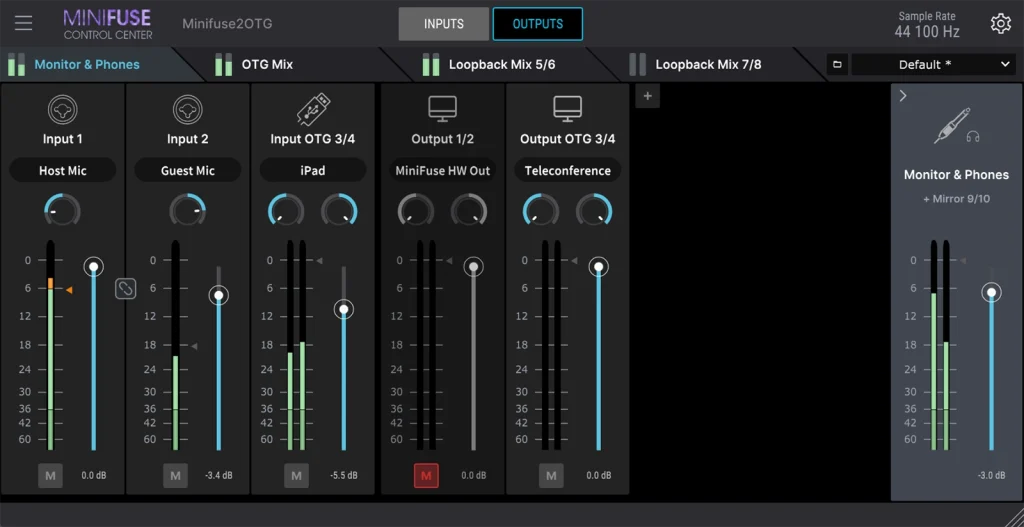

Unlike the standard MiniFuse, the MiniFuse OTG has a mixer and offers capabilities similar to those of the higher-end AudioFuse audio interfaces. Although it has only two physical inputs and outputs, it offers additional submixes and controls for OTG and virtual channels. This allows you to run multiple audio applications and create a mix, which is necessary for internet streaming and monitoring with headphones or speakers.

The inputs tab allows you to monitor the signal level and switch the direct monitor type between mono and stereo. The USB SOURCE button duplicates the physical switch on the front panel of the device.
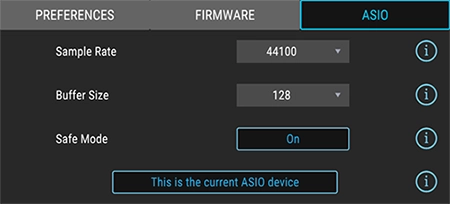
The ASIO panel has a buffer selection with all standard parameters and a selectable buffer ranging from 8 to 2048 samples. The Safe Mode checkbox provides additional buffering for the USB bus, which eliminates clicks on weak computers.

The device can be updated with firmware published on the official website. We have not noticed any glitches in its operation thus far, so we hope that this option will not be necessary.

The latency is very low at 5.8 ms with a 64-sample buffer. The output latency will be even lower.
The Arturia MiniFuse OTG operates in various modes up to 192 kHz. The system displays four virtual devices: MAIN 1/2, OTG 3/4, Virtual 5/6, and Virtual 7/8. The last two can be used as inputs for recording, broadcasting, or streaming applications.
Before preparing our Arturia MiniFuse 2 OTG review we studied the results of RMAA testing on specialized sites. In general, the measurements are very good. They confirm the passport parameters of the stereo codec. The spectrum is clean, and no problems were revealed by the measurements. For an inexpensive device, the results look decent.
We recorded the voice using a Neumann TLM102 condenser microphone and compared the results using the same equipment and conditions on a MOTU M2 audio interface. The two recordings were almost identical, with no differences in timbre or sound detail. This speaks to the high quality of the electronic components in the Arturia MiniFuse 2 OTG. Overall, the device was convenient to use. We had no questions or complaints. The developers have fine-tuned the interface through extensive testing with bloggers, and it is ready for use.
It's worth mentioning the software that comes with MiniFuse devices: It includes Ableton Live Lite, Analog Lab Intro virtual instruments, Arturia FX effects, the Steinberg Cubase LE sequencer, the Steinberg Cubasis mobile app, the Izotope VEA (Voice Enhancement Assistant), the Hindenburg PRO, the Auto-Tune Unlimited, and the Splice Creator Plan. You can obtain a license for the software after registering on the official Arturia website.
Finally, we've reached the end of our Arturia MiniFuse 2 OTG short review, it's time to summarize the results. The Arturia MiniFuse OTG is a further development of the MiniFuse line. The company has now shifted its focus to a large group of streamers and bloggers. The French manufacturer have something to offer here. The MiniFuse 2's professional interface, with its high-quality preamps and reliable drivers, has been fully adapted to the needs of internet broadcasters. Even if you are a regular musician, the Arturia MiniFuse OTG will be the preferred choice due to its advanced professional mixer and more comprehensive modern software package.
We hope you enjoyed our review of the Arturia MiniFuse 2 OTG audio interface. Please feel free to leave your comments, questions, and suggestions in the section below. We will be happy to answer them all as soon as possible. If you already own MiniFuse 2 OTG and have used it for a while, don't forget to share your impressions and tell us what you liked or disliked about this audio interface.
Pros
|
Cons
|
9.5
/10
Our Score
|